


The bowl that was born to keep you warm. The ramen equivalent of the weighted blanket.
A Little History
If shoyu ramen is Tokyo’s gift to the world, miso ramen belongs to Sapporo. And unlike a lot of ramen origin stories, this one has a name, a place, and a very specific bowl of soup.
In the early 1950s, a chef named Morito Omiya ran a small ramen shop called Aji no Sanpei in Sapporo, Hokkaido, Japan’s northernmost island, where winters are brutal and the wind cuts through you like a knife. At the time, most of Sapporo’s ramen shops were serving shoyu, just like everyone else. The story goes that a customer, reportedly a drunk one asked Omiya to put noodles in his miso soup. Omiya thought about it. And then he kept thinking about it.
What followed was years of experimentation. Omiya tried miso from nearly every region of Japan, testing different fermentation levels, different salt contents, different flavor profiles. He eventually partnered with Nishiyama Seimen, a Sapporo noodle maker, to develop a noodle that could stand up to the heavier, richer broth, the thick, wavy, yellow noodle that is now synonymous with Sapporo-style miso ramen. In 1955, miso ramen officially debuted on the Aji no Sanpei menu. It changed everything.
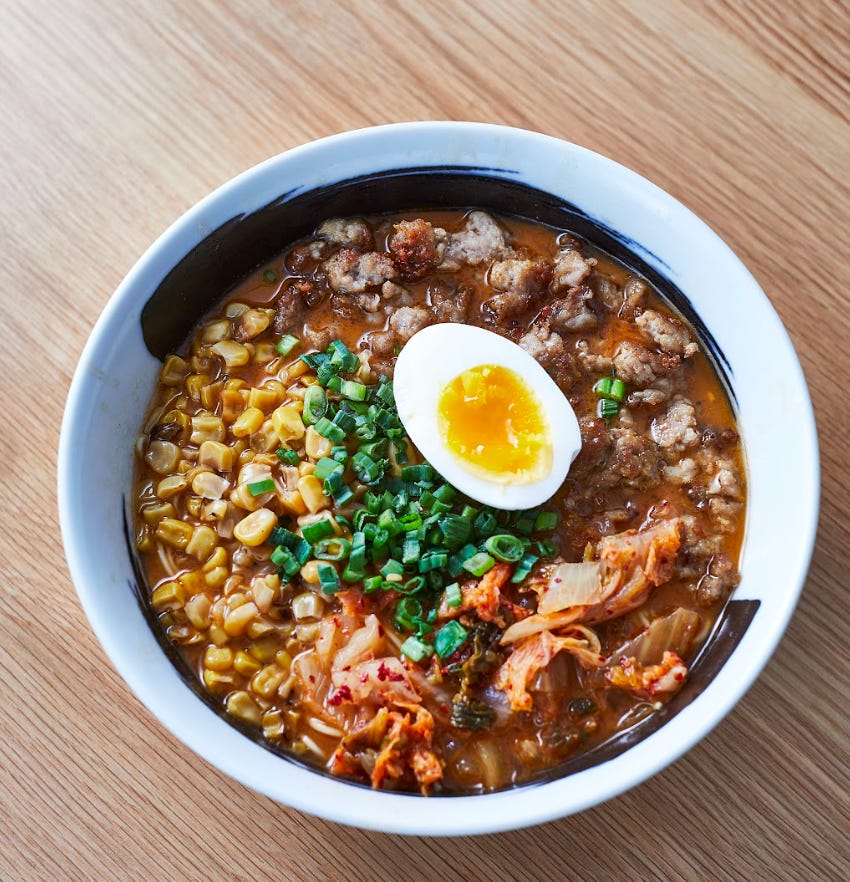
By the 1960s, miso ramen had exploded across Hokkaido and was making its way south. Shops in Sapporo began refining the style: richer pork broths, lard or pork fat cooked directly in a wok with the miso paste, topped with bean sprouts, corn, butter, and ground pork. The wok technique became the defining characteristic—the thing that separated a bowl of miso ramen from a bowl of miso soup with noodles in it.
Ivan Orkin said it best when I interviewed him for my book: “In my eyes the only proper way to make miso ramen is in a wok because really good miso ramen is an emulsification of miso and soup and a healthy dose of pork fat. Heat it at a really high temperature in a wok and it all comes together. In Japan it is a very complex thing to serve because if you don’t do it right it can taste just like miso soup with noodles in it.”
That’s the whole game. The wok.
