


The Heart of the Bowl
I get asked all the time — what makes ramen, ramen? People think it’s the broth. They think it’s the long simmer, the bones, the tare. And yes, those things matter. But the truth is, the thing that makes a bowl of ramen different from every other noodle soup on the planet is the noodle itself.
Specifically, it’s the alkaline noodle.
Without kansui — the liquid alkaline salt added to the dough — you don’t have a ramen noodle. You have an udon noodle. You have pasta. You have something else entirely. It is an industry rule in Japan: if there is no kansui, it cannot officially be called a ramen noodle. Full stop.
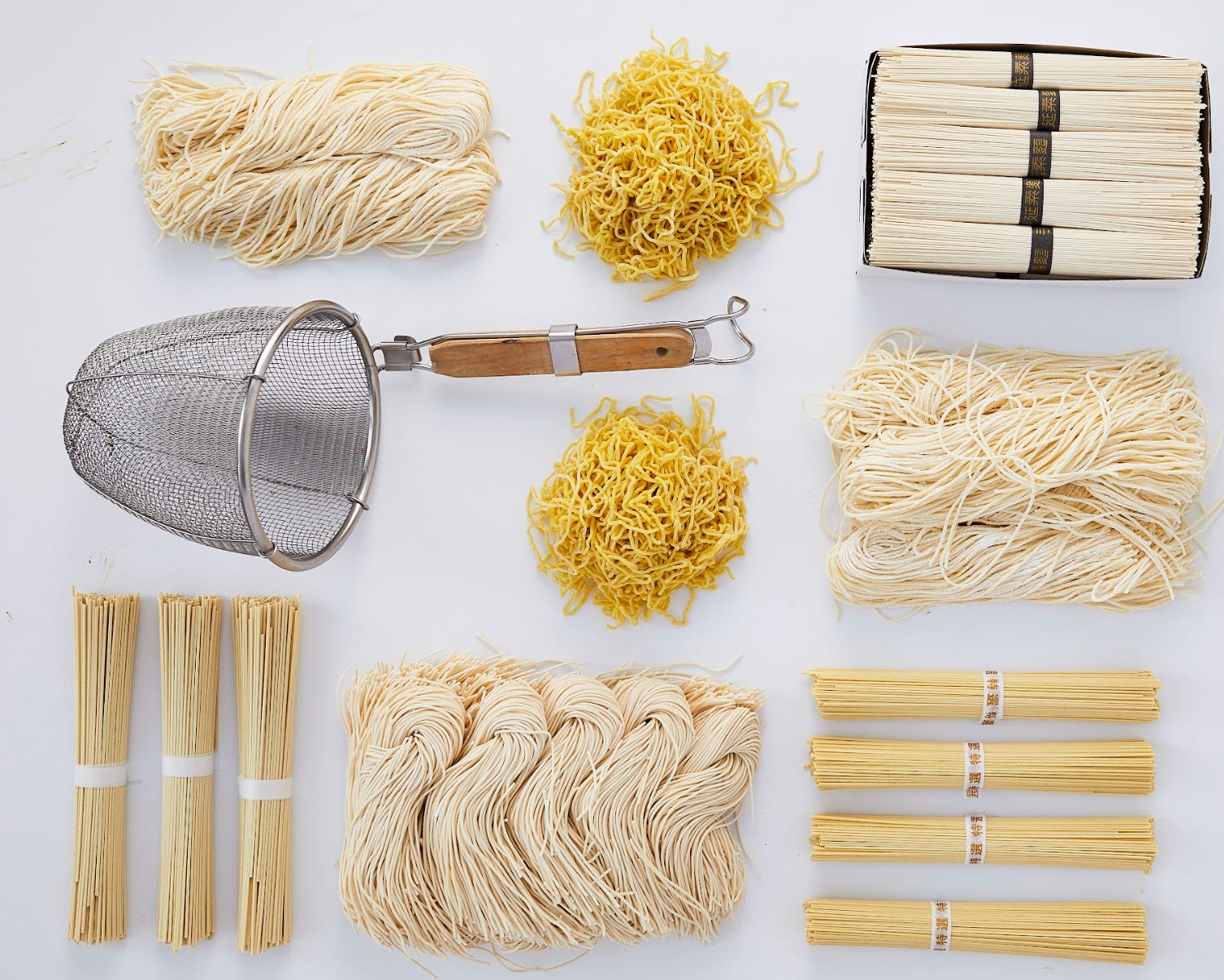
Kansui is what gives the noodle that unmistakable snap when you bite into it. That slightly springy, slightly chewy, almost elastic texture that holds up in scalding hot broth instead of turning to mush. It’s what gives the noodle its characteristic yellow hue — not egg, despite what people assume. And it’s what creates that faintly mineral, wheaty aroma that hits you the moment the steam rises off the bowl.
The Lore of the Noodle
The ramen noodle came from China. That’s the short version. The longer version is that in 1858, Japan signed the Treaty of Amity and Commerce, which opened its ports and allowed an influx of Chinese immigrants for the first time. Those immigrants brought their food with them, including a noodle made with kansui — an alkaline mineral water that occurred naturally in certain lakes in Mongolia and northern China. The Chinese had been using it in noodles for centuries.
In those early days, the dish was called shina soba or chuka soba — “Chinese soba.” It wasn’t Japanese food yet. It was Chinese food being served in Japan. But the Japanese did what the Japanese do: they took someone else’s idea and obsessed over it until it became something entirely new.
By 1910, the first ramen shop — Rairaiken — opened in Asakusa, Tokyo. The ramen was a clear chicken and pork bone soup with soy sauce seasoning, topped with roast pork, bamboo, and scallion. Sound familiar? That’s because this template became what we now call Tokyo-style ramen, and it hasn’t changed all that much in over a hundred years.
The Great Kanto Earthquake of 1923 pushed ramen stall operators out of Tokyo and into smaller towns across the country, and that’s when regional styles were born. After World War II, when food supplies were rationed and people were rebuilding from nothing, ramen became “stamina food” — nourishing, filling, made from whatever scraps you could get your hands on. But the one constant through all of it, from those first Chinese immigrants to the post-war ramen stalls to the 51,000-plus ramen shops in Japan today, is the alkaline noodle.
The noodle is the thread, literally and figuratively, that ties the entire history of ramen together.
Why Alkaline Matters
So what exactly is alkalinity? I’m not a chemist, and chances are neither are you. Here’s what you need to know: kansui is a solution of potassium carbonate and sodium carbonate. In powdered form, it’s essentially baked baking soda. It raises the pH of the dough, and that higher pH does several important things.
First, it tightens the gluten network. Ramen noodle dough is much lower in moisture than pasta dough — and that low moisture, combined with the alkaline environment, creates a dense, springy texture that can survive a bath in 190°F broth without falling apart. A good ramen noodle doesn’t just sit in the broth. It stands up to it.
Second, it changes the color. The alkaline reacts with the flavonoid pigments in wheat flour and turns the noodle yellow. No eggs needed. If you’ve ever wondered why ramen noodles look golden while Italian pasta is pale — that’s your answer.
Third, it affects flavor. There’s a subtle mineral quality to a good ramen noodle, almost wheaty and a little sweet. That’s the kansui talking. It also creates a specific aroma that is unmistakably ramen. You know that smell when you walk into a ramen shop? Part of that is the broth. But a big part of it is the noodles cooking.
The Rule
In Japan, if a noodle does not contain kansui, it cannot officially be called a ramen noodle.
No alkaline = no ramen. It’s that simple.
The Noodle Is a Delivery System
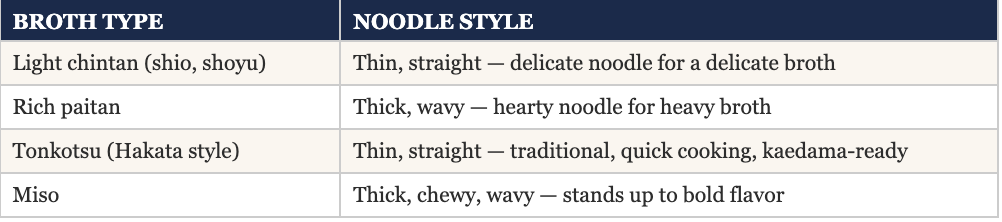
Here’s something most people don’t think about: the noodle is not just a component of the bowl. It’s a vehicle. When you slurp a well-balanced bowl of ramen, the noodles carry the broth into your mouth with them. The right noodle picks up the right amount of soup. That’s why noodle shape and thickness matter — it’s not just aesthetics. A thin, straight noodle moves through a delicate chintan differently than a thick, wavy noodle grabs onto a rich paitan.
In the ramen shop, every time we create a new bowl, one of the first things we do is test noodles. Thick, thin, wavy, straight, ribbon-like, long or short. The experience of each bowl changes dramatically based on which noodle you pair with which broth. Getting that match right is one of the most important decisions you’ll make.
Noodle Matching Guide
The Noodles You’ll See in a Ramen Shop
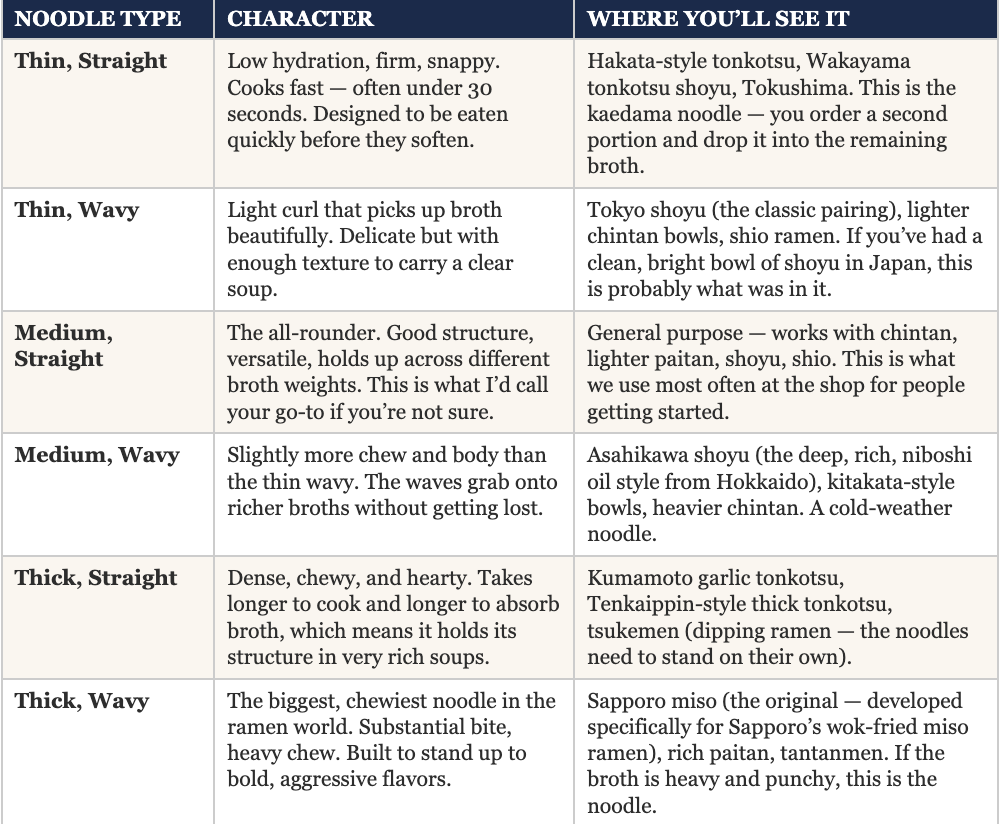
Walk into any serious ramen shop in Japan and you’ll notice that the noodle is never an afterthought. It’s been specifically chosen — or in many cases custom-made — to match the broth. Sun Noodle makes over 600 types for a reason. Every variable matters: thickness, shape, hydration, even the way the noodle is cut. Here are the main styles you’ll encounter and where they show up.
A Word on Kaedama
If you’ve eaten Hakata-style tonkotsu, you’ve probably seen kaedama on the menu. It means “extra noodles” — and it’s not just a portion upsell. It’s built into the design of the bowl. Hakata tonkotsu uses thin, straight, low-hydration noodles that cook in seconds and are meant to be eaten fast, before they soften. When you finish your noodles but still have rich broth left in the bowl, you order kaedama — a fresh portion of noodles dropped right into the remaining soup. The broth is concentrated enough that it can handle a second round. That’s the whole system: fast noodle, rich broth, repeat.
Why This Matters for You
You don’t need to memorize all of this. But I want you to understand the principle: the noodle is not interchangeable. You wouldn’t put a thick, chewy Sapporo miso noodle in a delicate Tokyo shoyu — it would bulldoze the broth. And you wouldn’t put a thin Hakata noodle in a rich miso — it would get buried. The noodle and the broth are partners. One should never overpower the other.
For home cooking, here’s the good news: a medium straight noodle is a solid all-purpose choice that will work across most of the bowls in this series. As you get more comfortable and start seeking out specialty noodles, you can start dialing in the pairings. But start with medium straight, nail the rest of the bowl, and build from there.
I Don’t Make Noodles
People always ask me, “Do you make your own ramen noodles?” And they have no idea what goes into that question.
The process of making ramen noodles is complex and nowhere near as simple as making pasta. The flour used by professional noodle makers is milled finer than talcum powder, the flour you can buy at a store is going to be twice as coarse. The moisture in the dough is incredibly low, and a few drops of water in either direction can make or break the entire batch. The best ramen machines don’t roll noodles, they express them, using calibrated weight to compress the dough. It’s the pressure that’s the key. That is not something you can replicate with a KitchenAid pasta attachment.
I don’t make noodles. That’s not me. I work with the pros who do. At the shops, I’ve worked with Sun Noodle since the very beginning, and they are hands down the gold standard. Sun Noodle makes over 600 different types of ramen noodles across their three factories, and they supply the best ramen shops in the country. My relationship with Kenshiro Uki and the entire Sun Noodle team is one of the most important relationships in my ramen career.
And now you can work with them too.
Where to Find Ramen Noodles
Fresh / Frozen
Sun Noodle is now available at Whole Foods. Let that sink in for a second. The same noodles that the best ramen chefs in America use are now sitting in your grocery store’s refrigerated section. This is a game changer for the home cook. Fresh and frozen noodles are always the ideal — don’t be put off by frozen, it actually preserves the noodle really well.
You’ll rarely see frozen ramen noodles that aren’t from a major producer, and when you do, they’re usually handmade by someone who really knows what they’re doing. If you spot them, grab them.
Dried
Here’s where I need to be honest with you: most of the dried noodles you’ll find in the Asian grocery aisle are not true ramen noodles. They don’t have the alkaline bite, the spring, or the structure. A lot of them are egg noodles that will go soft the second they hit hot broth. Stay away from anything that says “egg noodle” on the package.
That said, there is one dried noodle I swear by and keep on hand at all times. Look for “Chinese Alkaline Wheat Noodle” — you can find them at some Asian grocery stores, but my favorite source is Mala Market. They import directly from Sichuan, China. The dried alkaline noodle they carry is the best dried ramen noodle I have ever had, and I’ve tried a lot of them. It has the snap, the chew, and the structure that you need. I keep a stash in my pantry at all times.
Noodle Sourcing: Quick Reference
✔ FRESH/FROZEN: Sun Noodle (Whole Foods, Asian markets, sunnoodle.com)
✔ DRIED: Chinese Alkaline Wheat Noodle from Mala Market (malamarket.com) — imported direct from Sichuan
✘ AVOID: Anything labeled “egg noodle” — too soft, will disintegrate
✘ AVOID: Instant ramen noodles — deep fried, no spring, completely different texture
Cooking Your Noodles
However you source your noodles, the cooking method is the same: a large pot of unseasoned, aggressively boiling water. Follow the package instructions, but subtract a few seconds of cooking time. The noodles will continue to cook in the hot broth once they’re in the bowl. If you’re using fresh/frozen Sun Noodle, thaw them first, then boil for about 45 seconds, stirring occasionally to separate the strands.
And then — this is the important part — eat them fast. Ramen is a ten-minute meal. Maybe fifteen. The moment those noodles hit the broth, the clock is ticking. They’re absorbing liquid, they’re softening, and the flavor of the flour is bleeding into the soup. A bowl of ramen that sits for twenty minutes is not the same bowl that was placed in front of you. Crush your noodles first, slurp them hard, and don’t come up for air until the bowl is done.
The noodle is the heart of the bowl. It’s the thing that traveled from China to Japan with immigrants in the 1800s. It’s the thing that survived earthquakes and wars and food rationing. It’s the one non-negotiable: no alkaline noodle, no ramen.
You’ve spent all this time learning stocks, tares, oils, and toppings. Don’t shortchange the noodle. Buy the best you can find. Leave the noodle-making to the experts, and focus your energy where it counts.
RAMEN SCHOOL · OBSESSED by Sarah Gavigan · iamobsessed.substack.com
Luckily, I can find Sun noodles and the kits at Wegmans as well. It has been my excuse for not breaking out my stand mixer and beating up my KitchenAid pasta rollers. But the temptation is always there.