


“Salt Seasoning for Ramen”
The word tare (垂れ) comes from the Japanese verb tareru (垂れる), meaning “to drip” or “to hang down.” It’s the visual of sauce dripping from a brush onto grilled eel, or pooling at the bottom of a bowl waiting for hot broth.
The term first appeared as a standalone noun in the mid-1700s, with its specific application to sauces documented from around 1860. But the concept is older; tare miso, a simple liquid condiment made by straining fermented soybean paste through cloth to create a drippable consistency, appears in cookbooks from the Muromachi period (1336–1573), where it was used to glaze dishes like simmered yams and pheasant at samurai weddings.
In ramen, tare represents something more fundamental: the separation of seasoning from stock. A ramen shop keeps one pot of neutral broth simmering and uses different tare concentrates to produce shoyu, shio, or miso bowls from the same base. This modular system means consistent seasoning bowl after bowl, and it protects heat-sensitive ingredients, fermented compounds, dried fish aromatics - from degrading over hours of simmering.
The three main categories are shoyu (soy sauce-based), shio (salt-based), and miso. Shoyu tare is the oldest, born when late 19th-century Japanese cooks used soy sauce to temper the unfamiliar meat and garlic smells in Chinese noodle soups. Shio tare is the most transparent, literally and philosophically. It’s meant to amplify what’s already in the broth rather than impose its own character.
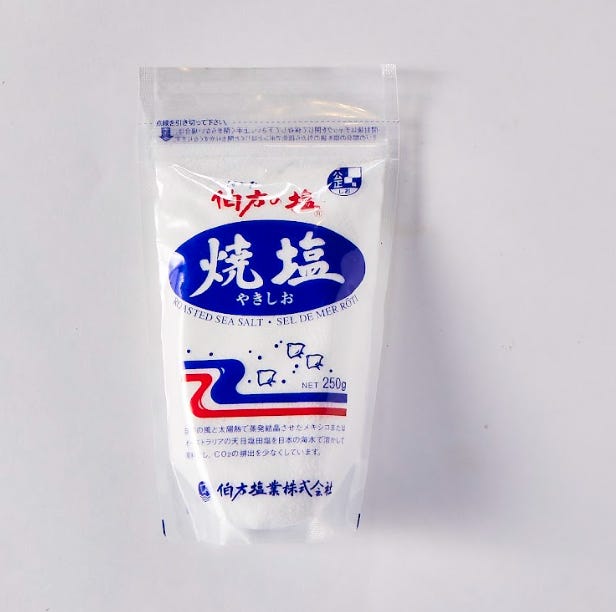
The Art of Salt in Japan
Here’s something that still blows my mind: Japan has over 4,000 varieties of salt. And these are not marketing gimmicks. They taste genuinely different from one another because of the mineral content of the seawater they come from, the method used to produce them, and where in Japan they’re harvested.
All Japanese salt is sea salt. The country has no natural rock salt deposits, so for centuries salt makers have developed extraordinary methods to turn seawater into crystals: sun-drying it on wooden platforms, boiling it in iron pots, running it through finely branched bamboo stalks, even burning seaweed and extracting salt from the ash (this is moshio, one of the most ancient salt-making techniques in the world, still practiced in the Seto Inland Sea). Each method produces a salt with a different texture, mineral balance, and flavor. Some are powdery and dissolve instantly. Some are flaky and bright. Some carry a faint sweetness from their calcium and magnesium content.
In Okinawa alone, Japan’s subtropical southern islands, surrounded by warm coral-reef waters loaded with minerals - there are hundreds of artisan salt producers. You can walk into a salt shop in Ishigaki and taste 56 different salts, all from Okinawa, all distinct. The textures range from what looks like powdery snow to gleaming translucent crystals to slushy opaque sherbet. Each one designed by its maker to do something specific in cooking.
What most people don’t know is that Japan had a government salt monopoly that forced everyone to use one standardized, refined salt. That monopoly wasn’t lifted until 1997. Once it was, the craft salt revival exploded. Small-scale artisan producers started popping up all along the coastline, obsessive about their process in a way that feels very Japanese - and VERY ramen otaku.
Together with fish and seaweed, salt forms what’s been called the “holy trinity” of Japanese cuisine. It’s the primary seasoning agent, the main preservation tool, and the essential ingredient in making Japan’s two greatest fermented seasonings: soy sauce and miso. Salt is not background noise in Japan. It’s the whole show.
