

The Backstretch, the Truth About the Saratoga Chip, and a Couch Nacho recipe you need for Tailgate Season
a Weekend in Saratoga Spring NY with my bestie, the horses, and who invented the potato chip

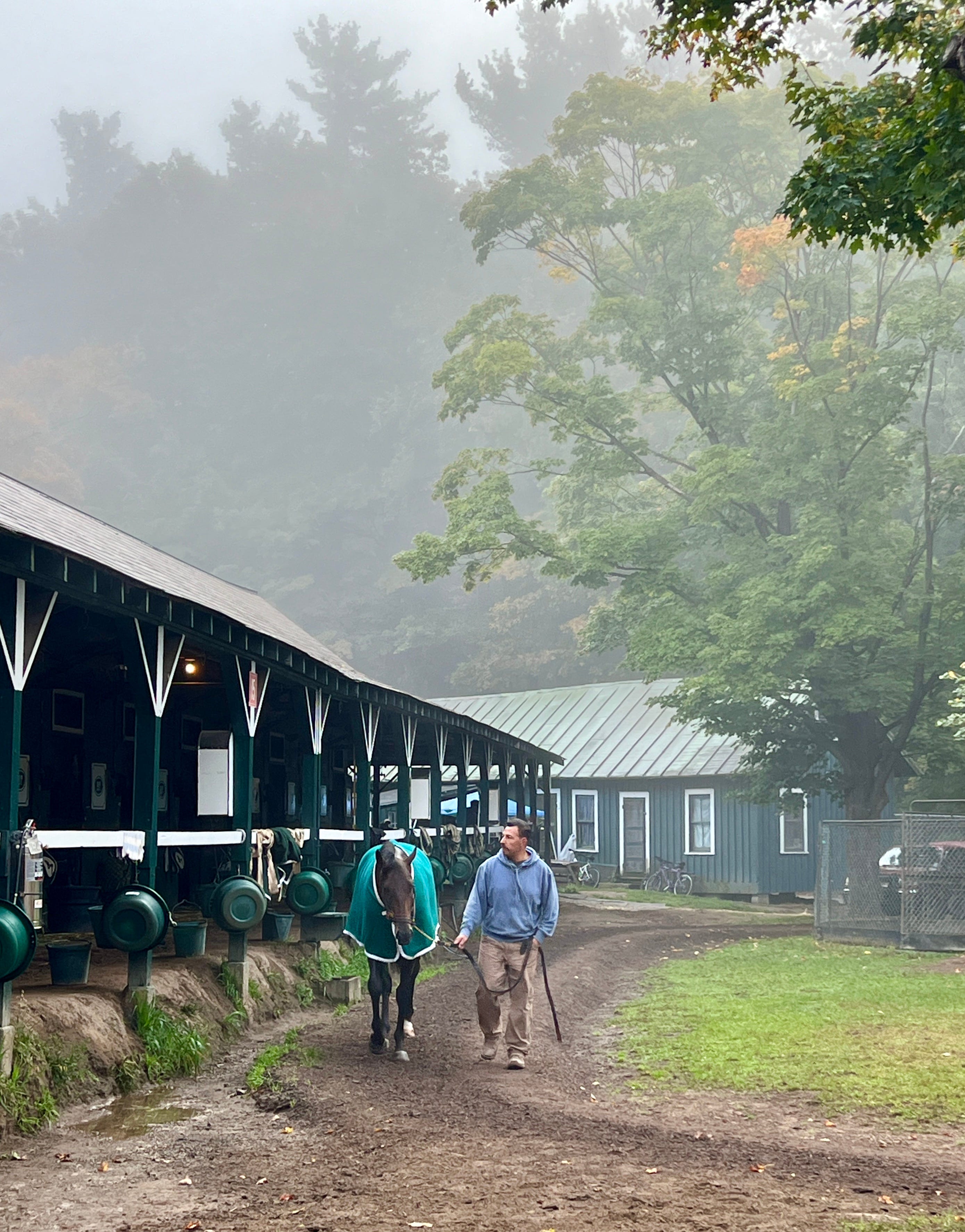
I am writing this from Saratoga Springs NY, where my friend Rachel works in horse racing, and where I have laughed and cried hard and deep like you do with old friends. I’ve also eaten more potato chips in three days than I will admit to my doctor.
Rachel and I have been friends for thirty years. In that time we have never, not once, met a potato chip we did not like. Kettle, ridged, flat, thick, paper-thin, salt-and-vinegar, sour-cream-and-onion, the weird wasabi ones at the airport, all of them. There is a kind of friendship that survives because the two of you keep showing up for the same small, stupid pleasures, decade after decade. Ours is built partly on chips, and great stories. And fun chips (thats’s another story).
Which is what makes this week’s setting almost too perfect to be real. Because Saratoga Springs, where Rachel is currently living her horse-racing life, is the town the potato chip is supposed to have been invented in. And I am rocking a king sized hangover, so this all just came together perfectly for all of us. Some history and a wicked little appetizer or couch nachos on call with pantry items whenever you need it. I am giving you a version to take for highfalutin tailgating.
8 a.m. on the backstretch
If you have never been to a thoroughbred training track at 8 a.m., it is unlike anywhere else. The light is low and misty in upstate NY this particular morning. The horses come past you at a working gallop; the sound a four-beat drum on the dirt, that you feel it in your sternum before you see them. The exercise riders are tiny on their backs. Steam comes off the horses in the cool air.
And then all of a sudden the gossip is out; “Sovereignty is running on the back track.” So we make our way over to see last year’s Derby winner train. He was stunning.
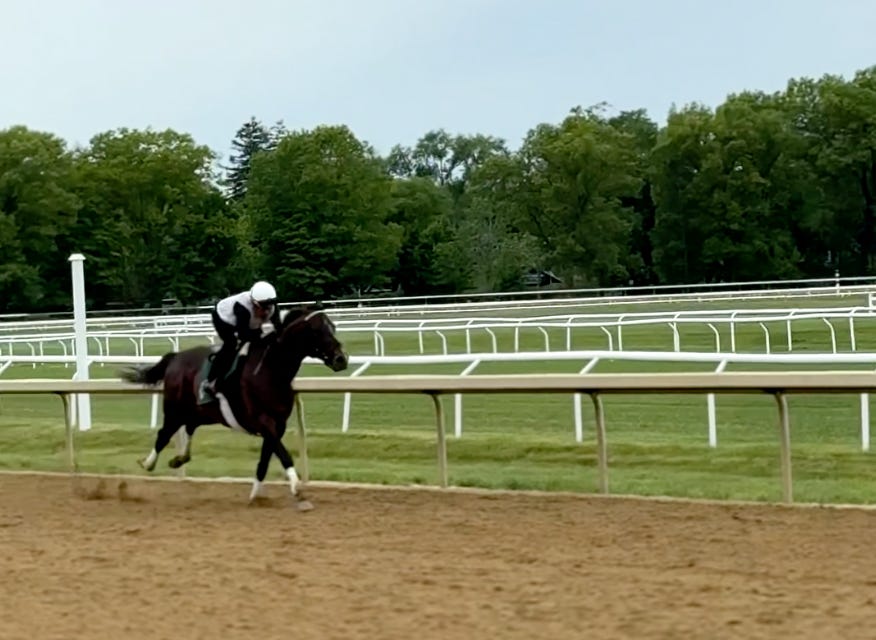
The backstretch is the part of the track most people never see the stables and shed rows behind the grandstand, where the actual work happens. Grooms, hot walkers, trainers, exercise riders, the same people there every morning at 5:30am. Rachel knows everyone. She has the kind of working knowledge of this place that you only get from years of showing up
We watched one of Rachel’s young fillies breeze for the first time in a workout, and I pretended to know what she meant. Even though this women has become a beloved and permanent fixture in the business of horse racing, she has never been on a horse, and as a former Hunter / Jumper rider, I love to tease her about it relentlessly, because what else is a 30 friendship for. But don’t be fooled, this woman knows her race horses, and I am so filled with pride for her success, I take any chance I can to join her on the backstretch and see the horses train and feel the buzz of the barns. If you love horses, it never goes away. The sounds, the smells, the connection. We stood and watched a 2 year old being shoed; his groom so deeply connected to this horse that he could feel the slightest twitch and instantly knew how to calm him. I had a bond like that with my horse when I was young, and it chokes me up every time I see it.
You leave the track hungry the way you leave a long swim hungry, your body has been working a little just by standing in the cold air paying attention. There is a specific kind of breakfast that wants to happen after backstretch hours. Eggs. Something fried. Likely hot coffee that has been sitting in the pot since 5 a.m.
We ate. We talked, the way you talk to someone you’ve known since you were in your twenties; fast, in shorthand, no preamble. And then she says, “Oh and by the way, the potato chip was invented here.”
Um, what?
We pulled up the racing version. Vanderbilt, the dining room at the lake house, a fussy customer. I had a feeling there was more to it than that.
There is.
The legend
The story most people in Saratoga tell goes like this. In 1853, at Moon’s Lake House on the shores of Saratoga Lake, a wealthy customer ordered the house specialty, Moon’s Fried Potatoes and sent them back. Too thick. Too soggy. Cut them thinner. The cook, George Crum, sent out a second plate. Sent back again. On the third try, Crum reached for a razor, shaved the potatoes paper-thin, deep-fried them in lard, and salted them aggressively, intending the dish to be inedible out of pure spite.
The customer loved them. Other diners started asking for them. They became the house specialty. Saratoga Chips were born.
Crum was a real person, born George Speck in 1824, of Black and Native American (Stockbridge-Munsee Mohican) heritage. He really did cook at Moon’s. He really did go on to open his own place, Crum’s House, on Malta Avenue, where he served Vanderbilt and Jay Gould and most of the Gilded Age summer set out of Saratoga.
That part is true.
The 1853-spite-chip part is where it gets interesting.
What historians actually find
The legend has problems. The Moons did not buy the Lake House until 1854, so the famous “1853” date doesn’t fit. And a New York Herald report from the same Lake House dated July 1849 already raves about “Eliza, the cook” there, whose “potato frying reputation is one of the prominent matters of remark at Saratoga.” Crisp fried potatoes were already a known thing at that restaurant four years before Crum is supposed to have invented them.
Crum had a sister, Catherine “Aunt Kate” Wicks, who worked the kitchen alongside him. Her obituary in 1924, when she was 103 years old claimed she was the actual originator of the chip. In one version of the story it is Kate, not George, who cuts the potatoes thin in a moment of pique. In another, she drops a stray peel into a pot of boiling fat by accident and has the eureka moment fishing it out. By the time historians went looking, at least five different people inside Moon’s had been credited with the invention at one point or another.
And the recipe itself? It predates Saratoga entirely. William Kitchiner’s The Cook’s Oracle a bestseller on both sides of the Atlantic published a recipe called “Potatoes fried in Slices or Shavings” in its 1822 edition. “Peel large potatoes… cut them in shavings round and round, as you would peel a lemon. Dry them well in a clean cloth, and fry them in lard or dripping.” Sprinkle with “a very little salt.” That is a salted potato chip. In a London cookbook. In 1822. Thirty-one years before George Crum allegedly invented one in upstate New York.
The Vanderbilt-as-the-fussy-customer detail, by the way, has no contemporary source. It got grafted onto the story decades later because Vanderbilt was a real customer of Crum’s later restaurant, and the legend wanted a celebrity.
So what actually happened in Saratoga?
This is the part I like.
The chip was almost certainly not invented in Saratoga Springs. But Saratoga is, by any honest reading, where the chip became the chip where it got a name, a reputation, a place on a menu, and a tourist economy carrying it back to dining rooms across the country. People came to take the waters, eat at the lake houses, lose money at the track, and bring home a memory of those impossibly thin, salty, crackling potatoes. That is the part of food history I simply love. Not just who technically did it first, but who turned a household trick into a thing the world had a name for.
There is a version of this story where George Crum is robbed of his rightful invention by historians who can’t leave a good legend alone. I don’t think that’s quite right either. He was a Black and Indigenous chef in a Gilded Age industry that erased people like him by default. The Saratoga Chip story being attached to him even if the details are wrong is one of the few places his name survives at all. That matters. The myth is doing real work even where the dates don’t add up.
That’s the fun of legend and food, history never REALLY knows what happened. And it is, somehow, the most American food story I can think of.
The recipe, finally.
Here is what I want you to do with a bag to impossibly thin and crispy kettle style chips.
There is a Spanish dish called huevos rotos “broken eggs” fried eggs slid over crispy potatoes, the yolks broken with a knife so they soak into everything underneath. It is a tapas-bar staple. It is one of the great hangover foods of Europe. It is also the obvious move when you have a bag of thick kettle chips and want to make a serious couch snack - fancy tailgate - appetizer out of them.
This is huevos rotos meets nachos. The chips are the platform. The Spanish pantry does the rest. You eat it directly from the bag (we mix and put them back), on the back of the tailgate, with your hands, and hopefully a crisp white wine or a great lager.
P.S.
If you are new here OBSESSED runs free posts on Saturdays with paid recipes. You may have found me through my work with bone broth. The Definitive Guide to Broth & Stock is linked here for anyone who wants the framework that everything else in the system sits on top of.
This week’s post is a one-off, because I’m on the road and the road insisted. Back to the framework series next week.
Two requests:
If you make the Potato Chip Nachos, send me a picture. I want to see the broken yolks.
If you have a friend you have eaten chips with for twenty years or more — text them right now. Tell them you’re thinking of them. That’s the whole game.
Rachel, this one’s for you. Thanks for always being there when I fall, and for eating too many potato chips with me.✊
~ Sarah